Jubail Mangrove Park: a company planting day
What a company can do at Jubail Mangrove Park in Abu Dhabi, from a boardwalk visit to a permitted planting day, with the tide, the season and the cost.
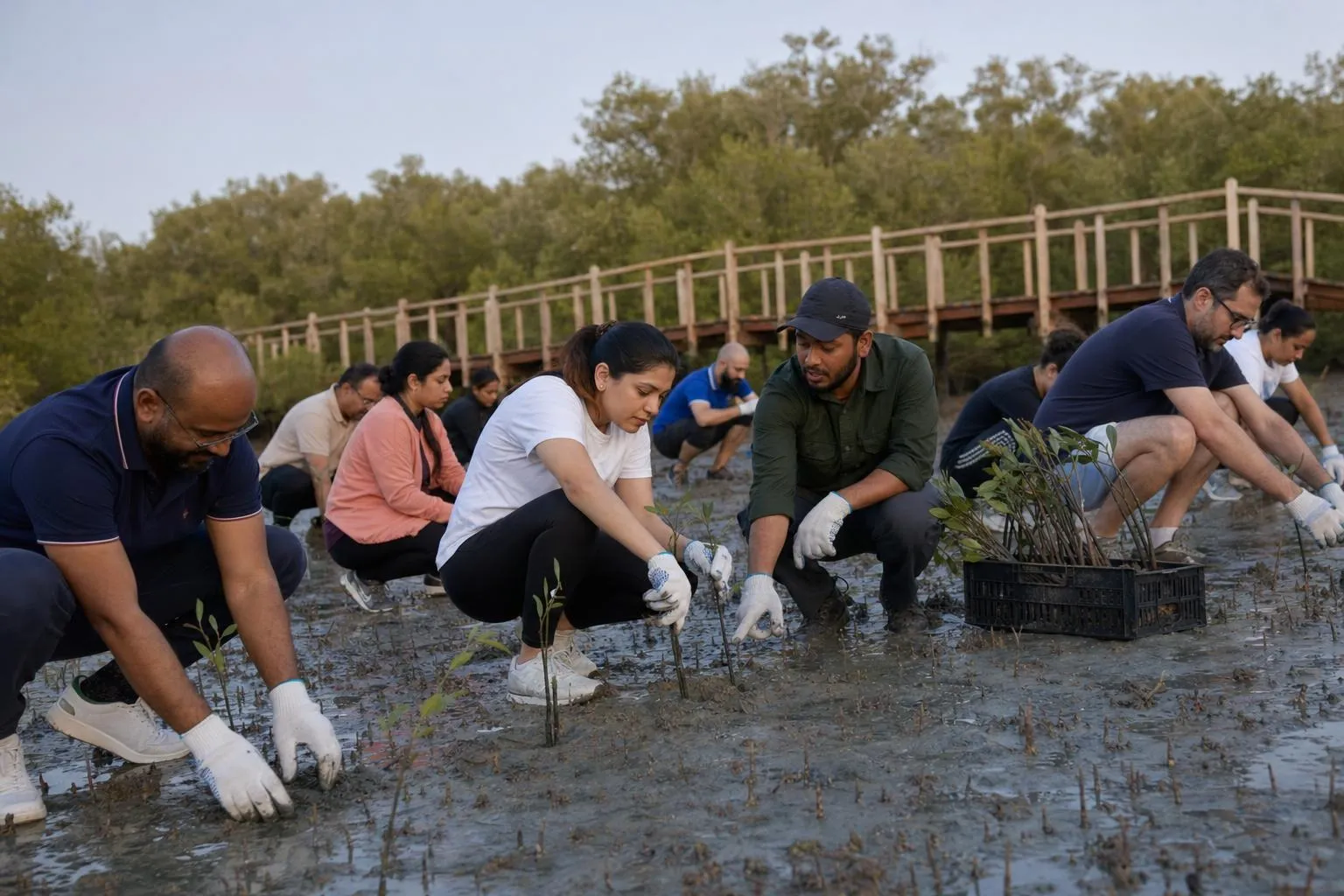
A company can do two quite different things at Jubail Mangrove Park: visit it, walking the boardwalk or paddling the channels as the public does, or plant mangroves on a permitted site with a licensed conservation partner. The second is the one that turns into a sapling count with your company’s name on it. It costs AED 420 per person for 20 to 29 people, AED 350 for 30 to 59 and AED 310 for 60 or more, excluding 5% VAT, runs October to April, and needs 21 days’ notice.
Here is what the park is, what each option involves, and the two things that catch people out: the tide and the permit.
What Jubail Mangrove Park actually is
The park sits on Jubail Island in Abu Dhabi and opened to the public on 30 January 2020. It is a boardwalk laid through a living mangrove stand rather than a garden built around one. The trees are grey mangrove, Avicennia marina, the species that dominates the UAE’s mangroves, and the point of the walk is to be inside the stand at eye level rather than looking at it from a car park.
When The National covered the park in February 2022, there were three boardwalk routes of roughly one, 1.6 and two kilometres, with the longest taking 35 to 90 minutes depending on how often people stop. Herons and flamingos were among the birds listed, alongside fish and crustaceans in the water below. The same piece put the drive at about 60 minutes from Dubai Marina and under 25 minutes from Yas, Reem Island and Al Khalidiya, with free parking and a visitor centre with toilets and a café.
Opening hours and ticket prices have changed more than once since the park opened, and the published figures we found disagree with each other. Rather than repeat one that may be out of date, check the park’s own website before you plan a visit, and assume advance booking is expected.
The rules, as The National listed them, are the ones you would guess for a protected habitat: no pets, no fishing, no swimming, no food or drink on the boardwalk, no bicycles or scooters, and no touching the plants or wildlife. Children under 12 need an adult with them.
Visiting versus planting: what each one gives a team
| Option | What the team does | Who arranges it | Season | Cost |
|---|---|---|---|---|
| Boardwalk visit | Walk one of the routes, at your own pace or with a park ranger | You, through the park | When the park is open; cooler months are far more comfortable | Park tickets, priced on its website |
| Kayak or ranger-led session | Paddle the channels, or walk with a ranger | You, through the park | As above | Ticketed separately by the park |
| Root & Branch planting day | Two planting sessions on a permitted plot, a boardwalk walk-through, lunch, certificates | Us, with a licensed conservation partner | October to April | AED 420 at 20–29, AED 350 at 30–59, AED 310 at 60+, per person, excluding 5% VAT |
A boardwalk visit is a pleasant morning and a good add to a wider Abu Dhabi day. It is not a CSR activity, and it should not be written up as one. Nothing the team does on the walk leaves a mark on the place, which is exactly the rule.
Why planting needs a partner and three weeks
Planting is the part people assume they can organise themselves, and it is the part they cannot. Saplings go into a site allocated to a licensed conservation partner, under a permit that is specific to that site and that date. That permit is why our planting day needs 21 days’ notice, why there is no same-day substitute if it falls through, and why the ecology briefing at the start of the day spends time on why planting outside a permitted site is not something to try on your own initiative.
The practical result is that the day has very little slack in it. You choose a date three weeks out, the partner confirms the plot, and the plot is yours for that morning.
The tide sets the start time, not you
Mangroves grow in the intertidal zone, so the working window on a planting site is set by the tide, not by the office calendar. On the planting day, the pickup is usually 07:00 but can move within the 06:30 to 07:30 window, and if the partner moves the tide window inside the final 48 hours, the start time shifts while the date stays the same. We say this at the point of booking because it is the one thing that most often surprises people.
The tide also changes what a casual visitor sees. The National’s guide put it plainly: high tide gives water views from the boardwalk, and at low tide parts of the stand can look dry. If the walk is part of a wider day, it is worth checking the tide table for the morning you have in mind.
What the planting day looks like
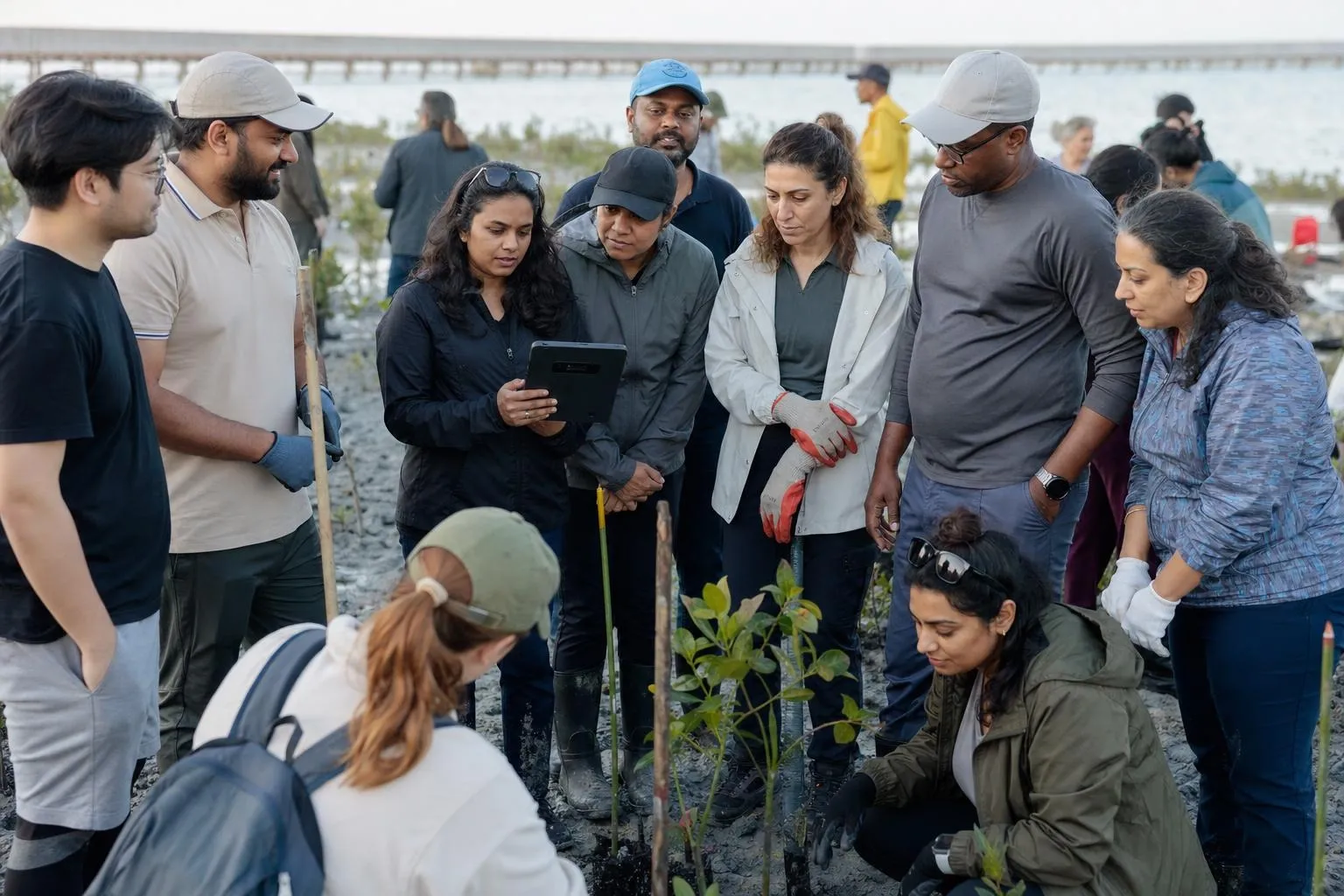
The coach leaves your office at 07:00 with breakfast on board and reaches Jubail around 08:30. The partner gives an ecology briefing at 08:45, and the first planting session starts at 09:15, in teams of four with one plot each and the saplings counted in as they are handed out. At 10:45 the group walks the boardwalk through the mature stand, which is the best argument for the work: it shows what the saplings are meant to become. The second planting session runs from 11:15.
At 12:30 there is a count-out, and each team is photographed at its own plot with its logged number. Lunch is an Arabic set menu in a reserved section at 13:00, certificates are presented at 14:15, and the coach is back at your drop point around 15:00.
As a rough guide, thirty people planting for three hours put about 300 saplings in the ground. That figure is the reason a sustainability team books the day, because it goes into the impact pack along with the count for each team, a GPS reference for the plot and a signed certificate.
What to plan for
Wear clothes and shoes that can get muddy. Planting is done in wet ground, and the people who enjoy the day least are the ones who came dressed for the office. Our guide to what to wear for team building in the UAE covers sun protection and footwear for outdoor days generally.
Know the weather triggers. We postpone for rain, wind above 25 knots or a forecast high above 34°C, as well as for a cancelled tide window. A genuine cancellation reschedules free within 120 days.
Decide early whether you want follow-up. Twelve months of survival monitoring with a photo report is AED 3,500 for the event, and an annual return visit to the same plot is AED 260 per person, both excluding 5% VAT. A 90-minute guided kayak through the channels can be added at AED 175 per person, excluding 5% VAT, for groups that want the paddle as well as the planting.
Where this fits
If you are weighing a planting day against the other ways a UAE company gives time, our guide to corporate volunteering and CSR in the UAE compares it with an indoor packing day and a Ramadan programme, including which one works in summer. If Abu Dhabi is the destination and the planting is one idea among several, our guide to team building in Abu Dhabi by season covers the rest of the emirate.
The practical next step: pick a date between now and April that is at least three weeks away, and tell the team the start time is set by the tide.
- Abu Dhabi
- CSR
- Sustainability
- Outdoor
Common questions
- What is Jubail Mangrove Park?
- A mangrove reserve on Jubail Island in Abu Dhabi, opened to the public on 30 January 2020, with boardwalk routes through the mangrove stand. When The National reported on it in 2022 there were three routes, the longest about two kilometres, and herons, flamingos, fish and crabs were among what visitors see.
- Can a company plant mangroves at Jubail?
- Yes, but not by turning up with saplings. Planting happens on a site allocated to a licensed conservation partner under a permit that is specific to the site and the date, which is why a planting day needs about three weeks' notice and cannot be moved to another location at short notice.
- How much does a corporate mangrove planting day cost in Abu Dhabi?
- A full planting day at Jubail, with transport from your office, the conservation partner, two planting sessions, lunch and an impact pack, runs AED 420 per person at 20 to 29 people, AED 350 at 30 to 59, and AED 310 at 60 or more, excluding 5% VAT. It runs October to April and needs 21 days' notice.
- Does the tide matter for a visit to Jubail Mangrove Park?
- It matters more than the weather. At high tide the boardwalk looks over water; at low tide parts of the stand can look dry. For a planting day the tide window sets the start time, which is why the pickup can move by an hour or two in the 48 hours before, while the date itself stays fixed.
Sources
Fees, dates and third-party prices in this post were read from these pages on the date shown above.