Team building games that work with adults
Why most team building games fail with a room of adult professionals, the five rules that separate the ones that work, and what each format costs per person.
There is a version of team building that adults endure, and a version they engage with. The difference is almost never the theme, the venue or the budget. It is the design of the game itself.
The rules below come from watching which sessions produce a room of people who forget they are at a work event, and which ones produce a semicircle of managers checking their phones.
The five rules
Everyone plays at the same time. The most common design failure is a game with one active participant and thirty spectators. Anything with a single board, a single course or a single stage will produce a queue, and a queue is where a corporate event goes to die. Every format worth running splits a group into simultaneous stations.
Teams of five to seven. Below five and there is no cross-talk. Above eight, two people quietly stop taking part — which is precisely the outcome the day was booked to prevent. Forty people is six teams, not four.
The winning skill must not be physical or hierarchical. If the fittest person wins, half the room has already lost. If the most senior person wins, nobody learns anything and everybody notices. Good games reward noticing, sequencing, dividing labour and communicating under a clock — skills distributed unpredictably across an org chart, which is the entire point.
Ninety seconds of rules, in plain English. UAE teams are multilingual by default. A game whose rules take four minutes and depend on wordplay will be understood by two-thirds of the room, and the other third will spend the round pretending. If the rules cannot be demonstrated faster than they can be explained, the game is wrong.
Nobody can be embarrassed by joining in. No singing, no dancing, no physical contact, no personal disclosure, no standing on a chair. This is not squeamishness; it is the difference between a group that participates and a group that finds a reason to be on a call. The rule that covers all of it: an activity is fine if the most reserved person in the company can do it without being looked at.
Formats that satisfy all five, and what they cost
Per-person, excluding 5% VAT, at the group sizes stated.
Structured competition, multi-station. Five or six short stations, teams rotating on a whistle, a running scoreboard. It is the default for a reason — it satisfies every rule mechanically, and it works with any age or fitness mix. AED 420 at 15–29, AED 300 at 30–59, AED 260 at 60 or more, four and a half hours including transfer, year-round indoors.
Cooking, as a competition. Brigades of six, a brief, a clock, a tasting. It carries an unusual property: the output is real and edible, so the scoring never feels arbitrary. AED 510 at 20–29, AED 430 at 30–59, four hours, year-round.
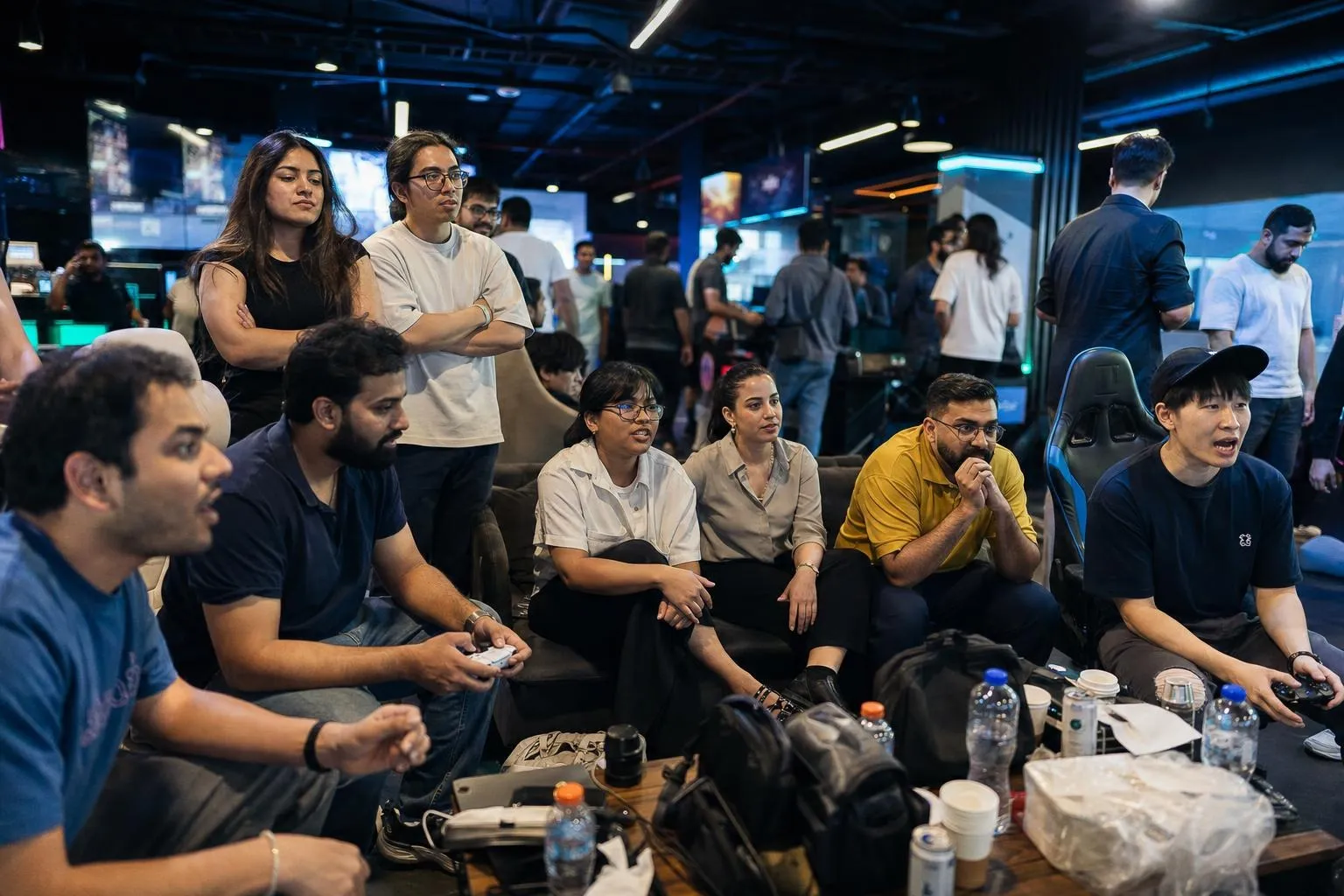
Esports and VR, private buyout. Several titles running at once so nobody watches. It is the format that most reliably converts people who say they do not like team building, and the age range it works across is wider than most people expect. AED 690 at 20–29, AED 620 at 30–49, AED 560 at 50 or more, four hours, fully indoor.
Racing. Timed heats, a grid, a published leaderboard. The clock does all the facilitation for you. AED 680 at 15–29, AED 570 at 30–59, AED 520 at 60 or more, four and a half hours including transfer; year-round at an indoor circuit, October to April outdoors.
A sport nobody has an unfair advantage at. Indoor cricket works in this market because most of the room has played some version of it and nobody is a professional: AED 440 at 24–39, AED 380 at 40–69, AED 340 at 70 or more. Padel works for the same reason and rotates well in short matches: AED 490 at 16–23, AED 420 at 24–47, AED 370 at 48 or more. Both are air-conditioned and run year-round.
Whole-company games day. Above fifty people the design changes: mixed teams, multiple simultaneous disciplines, a proper scoreboard and a closing prize-giving. AED 620 at 50–99, AED 480 at 100–199, AED 400 at 200 or more, six hours, October to April.
If the constraint is the room you already have rather than a venue, team bonding you can run in your own office covers the no-budget end of the same problem.
The games that reliably fail
Trust falls and anything requiring physical contact. Uncomfortable in any workplace, and a poor fit for a Gulf office in particular. There is no version of this that a mixed team of thirty enjoys.
Improvisation and performance games. They work brilliantly with the four extroverts and are actively unpleasant for everyone else. The room’s memory of the day will belong to the people who hated it.
One long puzzle for the whole group. Six people solve it, twenty-four watch. If you want a puzzle format, buy several rooms running in parallel, not one big one.
Anything scored on an opinion. If the facilitator decides who wins, the result is arguable, and somebody will argue. Score on a clock, a count or a taste test, and publish the running total where people can see it.
Departmental teams. Sales versus finance is not team building; it is the org chart with a scoreboard attached. Mix the teams deliberately and announce them on the day, not in advance.
The part everyone gets wrong: the prize
Two failure modes, both common.
A prize large enough to matter turns the day competitive in the wrong way — people stop playing and start arguing about rules. A prize of nothing at all makes the scoring pointless, and a scoreboard that leads nowhere is noticed by the second round.
What works is small, immediate and slightly silly: a trophy that stays on the winning team’s floor until the next event, a decent lunch voucher, a legitimate half-day. The cost is trivial. The recurring trophy in particular is the single cheapest thing you can add, because it makes the next event matter before it has been booked.
If you only remember one thing
Count the number of people who are physically doing something at any given minute of the session. If that number is less than 80% of the room, the format is wrong, and no amount of budget, venue or catering will fix it.
For what these formats cost across the whole market, how much team building costs in Dubai works through the four things that move the number. For which of them survive July, the indoor list is the year-round one.
- Team building
- Games
- Facilitation
- Guides
Common questions
- What are good team building games for adults?
- Good ones share five properties: everybody plays at the same time rather than queueing, teams are five to seven people, the winning skill is not physical strength or seniority, the rules survive being explained in ninety seconds to a multilingual room, and nobody can be publicly embarrassed by taking part. Escape-style puzzles, structured cooking, esports and racing formats, and multi-station sports rotations all satisfy those. Trust falls and improvisation games satisfy none of them.
- What are good indoor team building games?
- Formats built around simultaneous stations rather than one central game. A cooking challenge splits into brigades of six. An esports or VR buyout runs several titles at once so a group of forty is never watching four people play. A structured competition half-day rotates teams through five or six short stations. All three run year-round in the UAE and cost between AED 260 and AED 690 per person excluding VAT, depending on format and group size.
- How long should a team building game last?
- Twelve to twenty minutes per round, with a hard stop and a visible score. Adults disengage from a single game that runs past about twenty-five minutes, and a game with no clock has no tension. A four-hour session is therefore six to eight short rounds plus food, not two long ones.
- How many people should be in each team?
- Five to seven. Below five you lose the cross-talk that makes it a team activity. Above eight, two people stop participating and stand at the back, which is the exact failure the day was booked to prevent. A group of forty is six teams, not four.